
Where Błudnik Leads
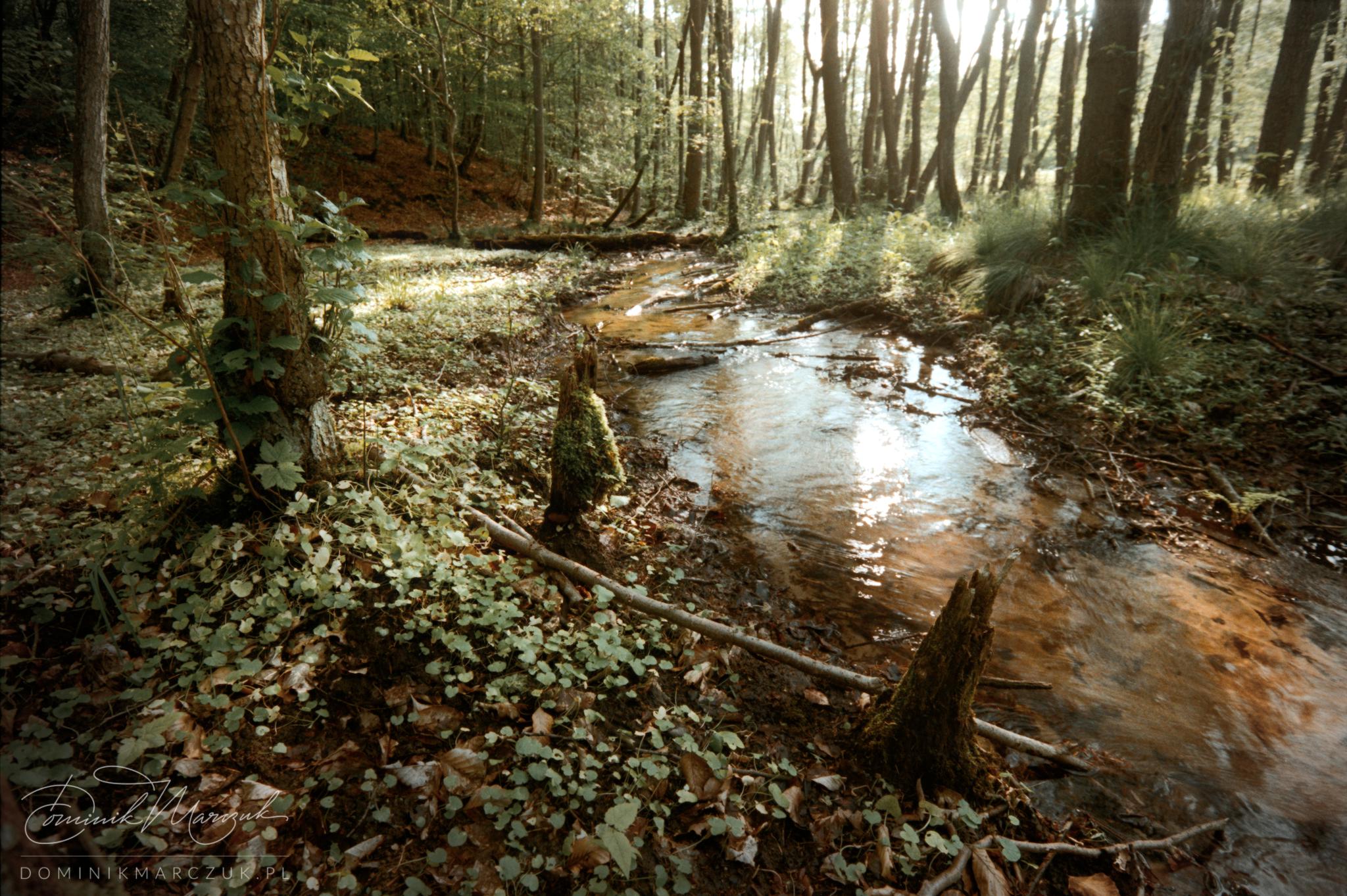
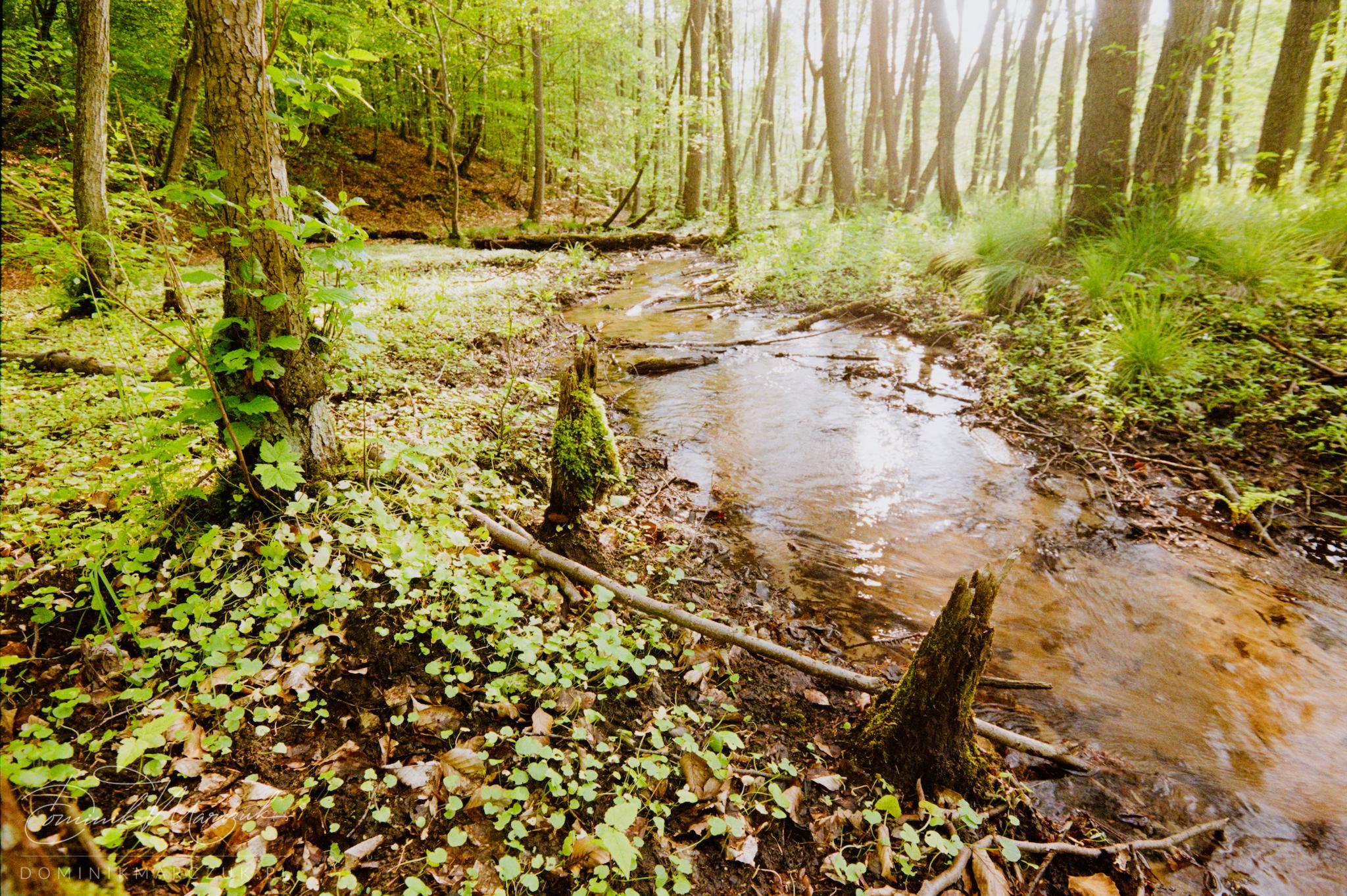
Here's an edit of another film photo: a view of a sunlit riparian forest surrounding Bernard's Stream in Gdańsk.
On 1st June 2025, I took my camera to document a lovely children’s party. I managed to fill half the film roll, and I don’t like leaving film in my cameras for long. So, in the afternoon, I went for a walk around my local area to finish the roll off with some easy filler shots. Little did I know, the walk would result in some of the best photos I’d taken so far in 2025. Here are two examples.
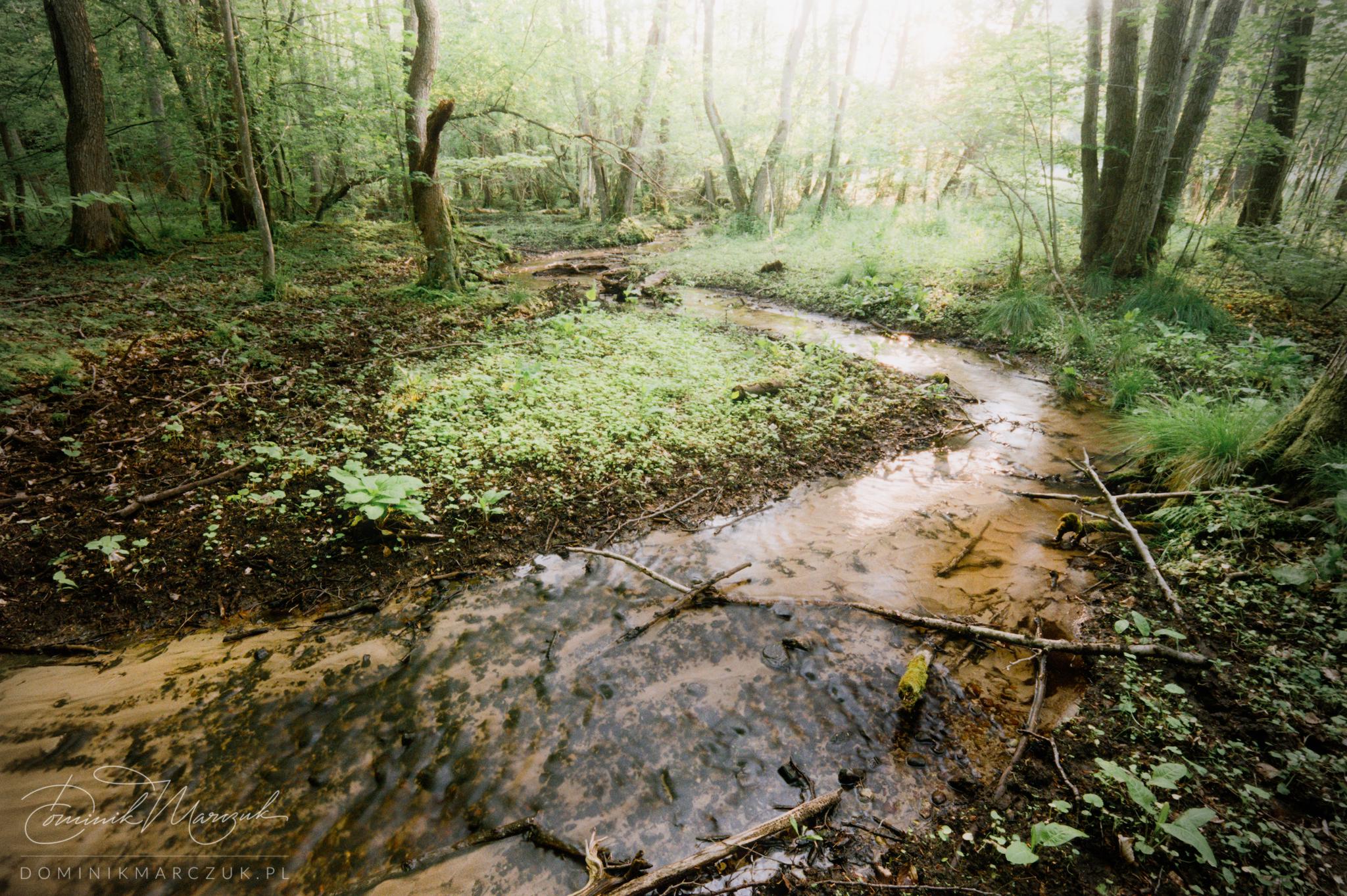
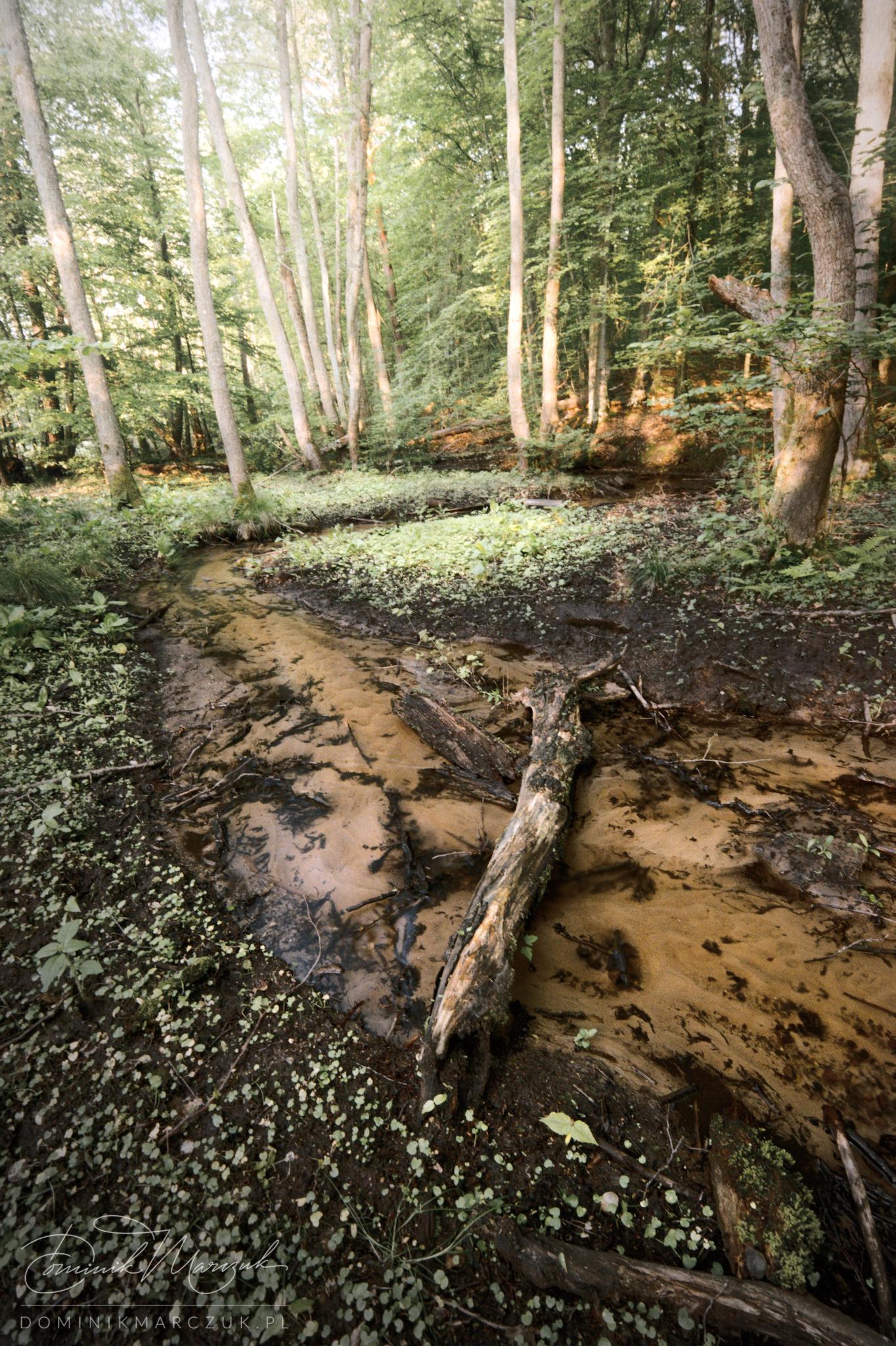
June afternoons are a poor time for photos: the sun is still high in the sky, and the light is far from flattering. I did what most people would in this situation: I sought a roof. Or more specifically, a canopy. I chose an area I visit quite often, merely a 10-minute drive from home: the Oliwa Forests, part of the Tricity Landscape Park.
I walked along Bernard’s Stream. It’s a little-known tributary of the much more famous Oliwa Stream. The area around it is a riparian forest, and these are notoriously treacherous, swampy and thick with mud. I’m glad I wore my trekking boots that day; they kept my feet dry as I waded ankle-deep through the slurping, belching stuff. Worth it, though.
The stream flows from west to east, so my choice of angles was usually limited to two: sun in the frame, or sun behind me. The former choice required me to hide the sun behind trees, but with some careful framing, it was entirely possible. In fact, it ended up making the sun, or sunlit patches of vegetation, the undisputed stars of my compositions.
Most of my shots relied on long exposures to smooth the flowing water out. This particular scene was different. I chose to open my aperture to f/5.6 and shoot at 1/10 s. This enabled me to preserve most of the water’s texture while still having obvious movement. The sun was in the frame, so I positioned the camera in such a way that the trees in the background obscured it. The scene was still fairly high-contrast, but not outside of my film’s dynamic range.
When I finally scanned the negative, I was spoiled for choice. There were at least six good frames to choose from. This particular one stood out as one of my favourites, with foreground interest in the form of the rotting tree stumps, and the stream acting as a guiding line inwards, to the blinding sun shining through the trees.
Gear
In case you’re curious: my gear on that day consisted of my Nikon F100, loaded with the remainder of a roll of Kodak ColorPlus 200. I had two lenses on me: my Nikkor nifty fifty and a super-wide zoom. I ended up using the latter exclusively.

Nikon F100
My first film camera was the Nikon F100. Here are my feelings about the gear.
Edits
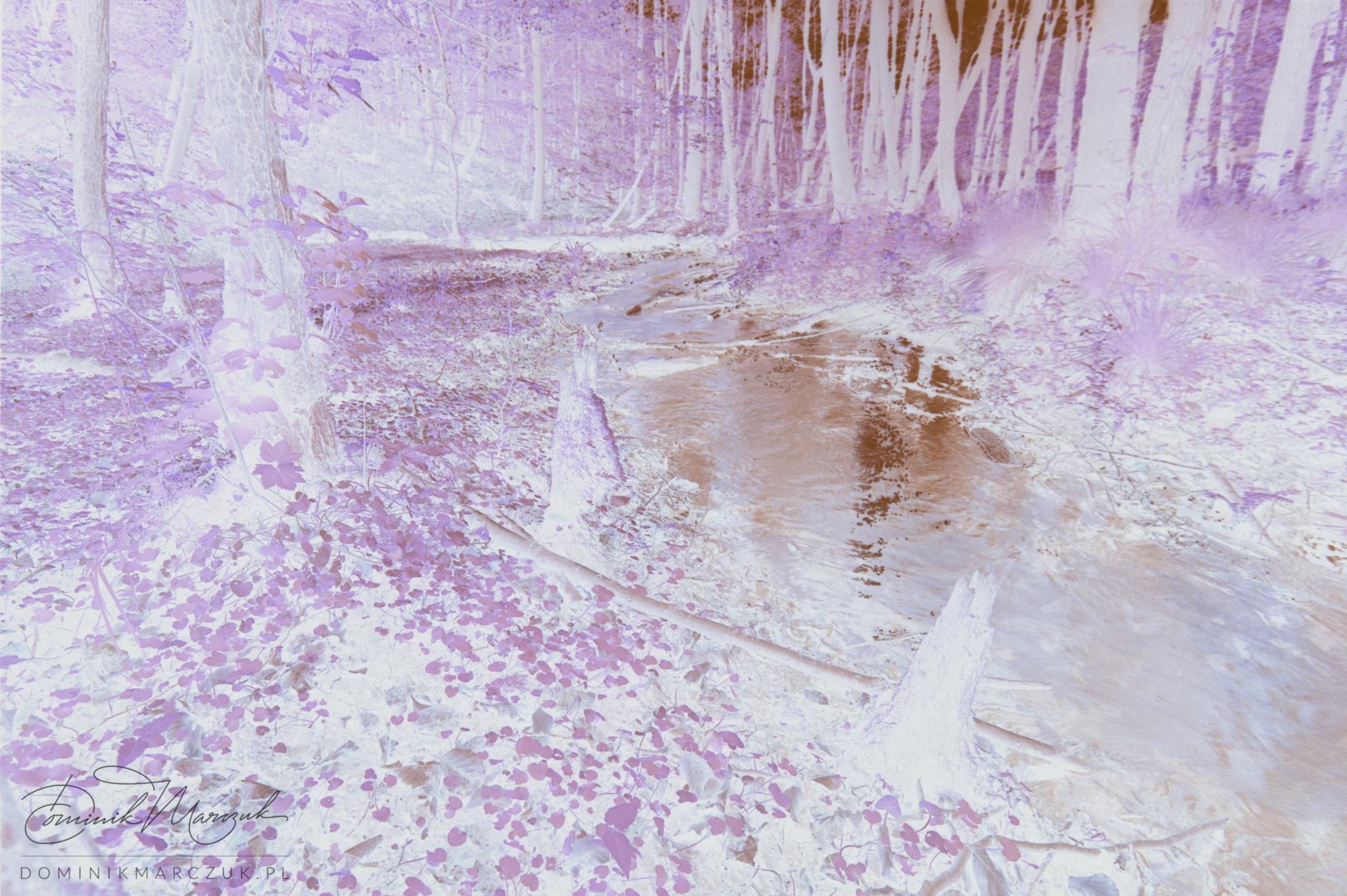
I started off with a mostly purple negative image. This is natural: the shot was filled with lush vegetation, which shows up as purple on a negative. ColorPlus 200 has visible grain, at least on my high-resolution scan, so I decided to use a trick: before applying any edits, I passed the image through a light diffuse step using a negative dehaze to blur the grain ever so slightly, making subsequent colour edits more precise.
A simple conversion to a positive left me with an overwhelmingly green, sickly-looking image. The even, flat illumination failed to concentrate and guide the viewer’s eye. Those were the two things to fix: the colour and the lack of focus.
The shade of green I started off with wasn’t just unappealing; it was nothing like how I remembered it. It’s a common problem, which I typically solve with some desaturation. Other colour edits (a subtle shift of the yellows and oranges towards red, saturation increase on all warm tones and the blues) provided pleasant colour separation.
A global exposure decrease, paired with a further deepening of the shadows, provided some much-needed contrast. The image was no longer flat.
To guide the viewer’s gaze through the frame, I burned the sides and applied a vignette on top of that. This submerged the shores in shadow, leaving the stream and the sunlight peeking through the trees as the first things to catch the eye.
Elevating the sunlight to the true star of the show required some work on the top part of the frame. I ended up applying a subtle bloom, dodging the whole area, and applying a slight negative dehaze.
To add a tiny bit of drama and interest, especially to the stream and the rotting tree stumps in the foreground, I needed to apply some dodging and burning. Dodging included the sunlit sides of the foreground stumps and trees and the sky reflections in the stream. I also enhanced the streaks of light on the vegetation seeping in between the trees in the background. As for burning, I darkened what was already naturally dark: shaded parts of trees and stumps, the black mud on the stream bank, tree shadows on the ground, plus some areas on the left third of the photo.
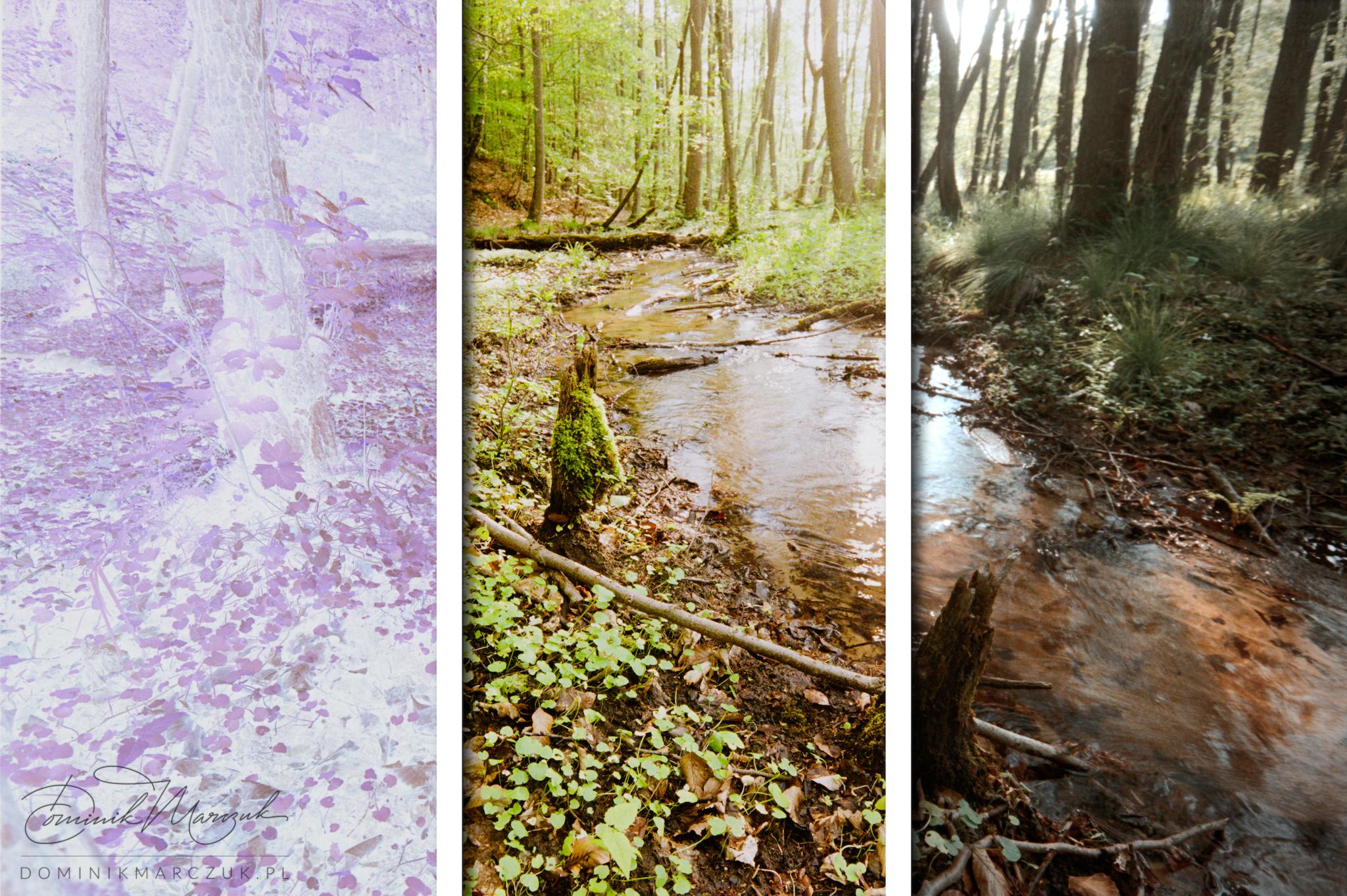
At this point, I was left with the final image. Here’s a before and after: the negative, the positive and the final edit.
What I’d Do Differently
The diffusion step at the beginning of the edit failed to provide the effect I was looking for. The idea was to slightly dissolve the individual grains without affecting the overall detail. I’d been subjecting many images to this treatment recently, but the colour edits were only marginally easier to pull off, and detail did suffer.
It could be that the diffusion should be applied with different settings, or perhaps using the dedicated diffuse & sharpen module, but I find that the photos are generally better off without it. For online publishing, this is fine, but I’ll consider undoing this particular edit before ordering a print.
Note on the Title
While I don’t title all of my photos, I planned to publish this one on social media and decided to give it a title. After some research, I stumbled upon a mention of a Slavic folklore creature called the Błudnik. I hadn’t heard of it earlier, but it seemed to fit the atmosphere of the image. The information on these creatures is scarce and mostly derived from 19th-century ethnographic works, so it’s questionable at best, but the fit was perfect.
A Błudnik (a word derived from błąd, meaning “error” or “mistake”) was a Slavic equivalent of a will-o’-the-wisp: a malicious creature that manifested itself as a light hovering over swampy areas, leading travellers astray, possibly to their demise. I too walked through a swampy area, even though it was not strictly a swamp. The terrain was treacherous, and there was a light in the distance, drawing me towards it. Photographically, of course.
Hence, “Where Błudnik Leads”.