
Belfoca
I stumbled upon a 75-year-old camera and took photos with it.
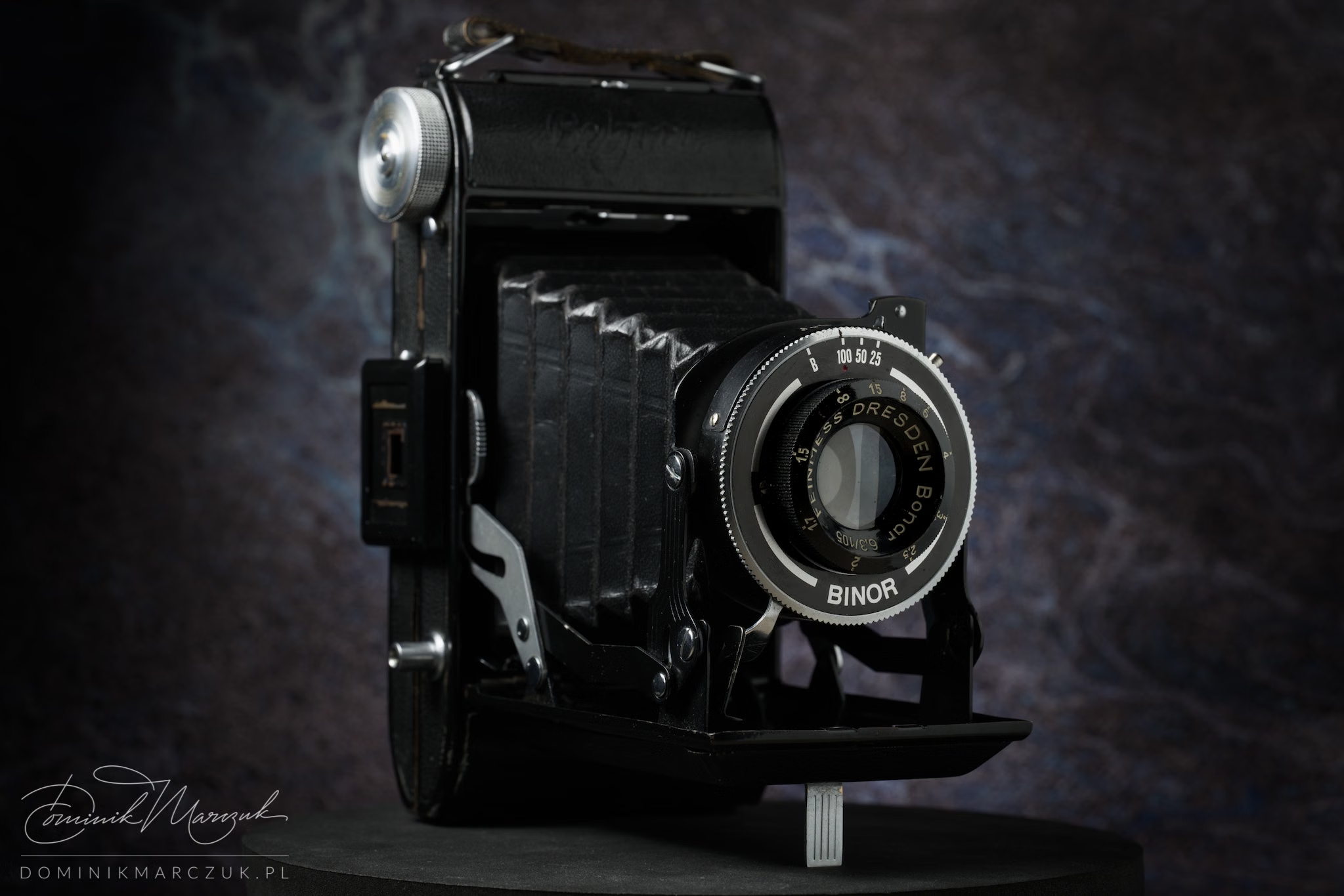
In 1950, a camera geared towards the advanced amateur photographer was released in post-WWII East Germany: the Belfoca. It was a copy of the 1934 Zeiss Ikon Nettar, originally produced by a company named Balda. After the war, Balda’s owners relocated to the West, and their Dresden-based facilities were nationalised. Due to a legal dispute over the name, the enterprise was rebranded as Belca. From 1957 onward, production was taken over by Welta after they absorbed Belca.
The Belfoca came in two versions. I have the earlier one, retroactively dubbed the Belfoca I only after the Belfoca II was released. The camera proved quite popular, prompting several manufacturers to produce lenses for it. It also shipped with four different shutters - two multi-speed and two three-speed. Varying lens and shutter combinations commanded different price points, meaning some variants sat firmly in the “budget” category. Mine is one of the cheaper configurations, featuring a three-speed Binor shutter paired with a 105 mm f/6.3 Bonar lens manufactured by Feinmess Dresden. It is a simple, uncoated triplet. As far as I know, all Belfoca lenses were Cooke triplets, though the more expensive models featured coatings and brighter maximum apertures.
The camera shoots 6x9 negatives, large enough to yield usable contact prints. To save film, a metal mask can be inserted to shoot 6x6, provided it hasn’t gone missing over the decades. I have mine, though I don’t necessarily plan to use it. Red windows on the backing paper align with both the 6x6 and 6x9 frame numbers. There is no red window for 6x4.5 numbers, so even if a custom 3D-printed adapter frame were used, spacing the shots correctly would prove challenging.
Unlike the Nettar, the Belfoca transports film from right to left. This results in the frames appearing upside down on the negative strip, which looks a bit peculiar when it’s cut into two-image sleeves for archival storage.
Obtaining the Belfoca
When I first encountered the Belfoca, I was blissfully unaware that such a camera even existed. Following the passing of some relatives a few years ago, I was helping clear out their apartment. Amidst the usual piles of forgotten trinkets, dusty books, ancient magazines, and moth-eaten coats, I spotted a brown leather case. Initially mistaking it for a wallet or a small pouch, I opened it simply to see if anything was worth saving for the family. To my surprise, the case held an old camera. I was given permission to take it, so I did.
At first, I figured I would either sell it or keep it as a shelf ornament. It looked thoroughly useless and battered: the leatherette was peeling in multiple places, the linkage between the shutter button and the release lever was detached, the 6x9 film gate was crooked, and the lenses weren’t just hazy - they were outright milky. Taking photos with it seemed out of the question. Furthermore, having never shot medium format at the time, I was still entirely anchored to a 35 mm mindset.
Yet, over a year later, after gaining experience with three other medium format cameras, curiosity finally got the better of me. I took the Belfoca to a repair shop and showed it to a technician, asking if a return to working order was possible. He made no promises, but ultimately succeeded in fixing it.
It was time for a field test.
Shooting the Belfoca
By modern standards, the Belfoca is wonderfully primitive, and shooting with it is an eccentric experience for anyone accustomed to contemporary gear:
- There is no real viewfinder. A sports finder consisting of two metal wire frames offers a rough approximation of the lens’s field of view, but it’s hardly reliable.
- Focus is entirely a guessing game. While there’s a distance scale on the lens barrel, there’s no rangefinder mechanism. Accurate focus relies entirely on an educated guess and a stopped-down aperture. Luckily, the scale markings roughly align with reality - a fact I verified by taping a focusing screen directly to the film gate.
- There is no interlocking film transport. The Binor shutter lacks a cocking mechanism entirely (it’s an ever-set design, unlike multi-speed cousins like the Prontor), meaning film advance and shutter cocking are completely disconnected. Unintentional double exposures are painfully easy to pull off.
- The tripod mount is deeply flawed. The camera uses a shallow 3/8-inch tripod thread. A 3/8-to-1/4 adapter sticks out considerably, forcing the camera to balance precariously on a single off-centre peg when attached to a mounting plate. It’s wobbly and highly susceptible to vibration, ruining a fair share of early frames.
- Shutter speeds are severely limited. The Binor provides just three speeds: 1/25, 1/50, and 1/100 of a second (shared with the Junior shutter). Bulb mode is available, but the lens lacks a filter thread, making it impossible to mount ND filters for long exposures unless you use slow film in low-light environments.
Are there workarounds for these inconveniences? Perhaps. For my first outing, I loaded a roll of Rollei RPX 25 to make slow shutter speeds manageable. I didn’t address the other hardware quirks yet: camera shake claimed two frames, severe underexposure (entirely my fault) claimed another, and user error resulted in one accidental double exposure. Out of the remaining four usable frames, however, one was an absolute banger. I achieved a 12.5% success rate - not bad, all things considered.
During that outing, I also found solutions for a couple of the remaining hurdles. First, winding the film immediately after releasing the shutter entirely prevents double exposures; it simply requires a bit of discipline. Second, holding my smartphone against the back of the camera while running a viewfinder app allows me to previsualise shots far better than the sports finder ever could. Parallax is inevitable, but for landscape work, it hardly matters. As a bonus, the phone app doubles as a light meter.
The crooked film gate also left its mark on the negatives, imparting a slight, noticeable skew to every frame without causing uneven focus - implying the bent metal hasn’t compromised the flatness of the film plane. Combined with the rounded frame borders, it creates a wonderfully organic look. I have no intention of fixing it; I treat it as part of the camera’s unique charm.
Improvements
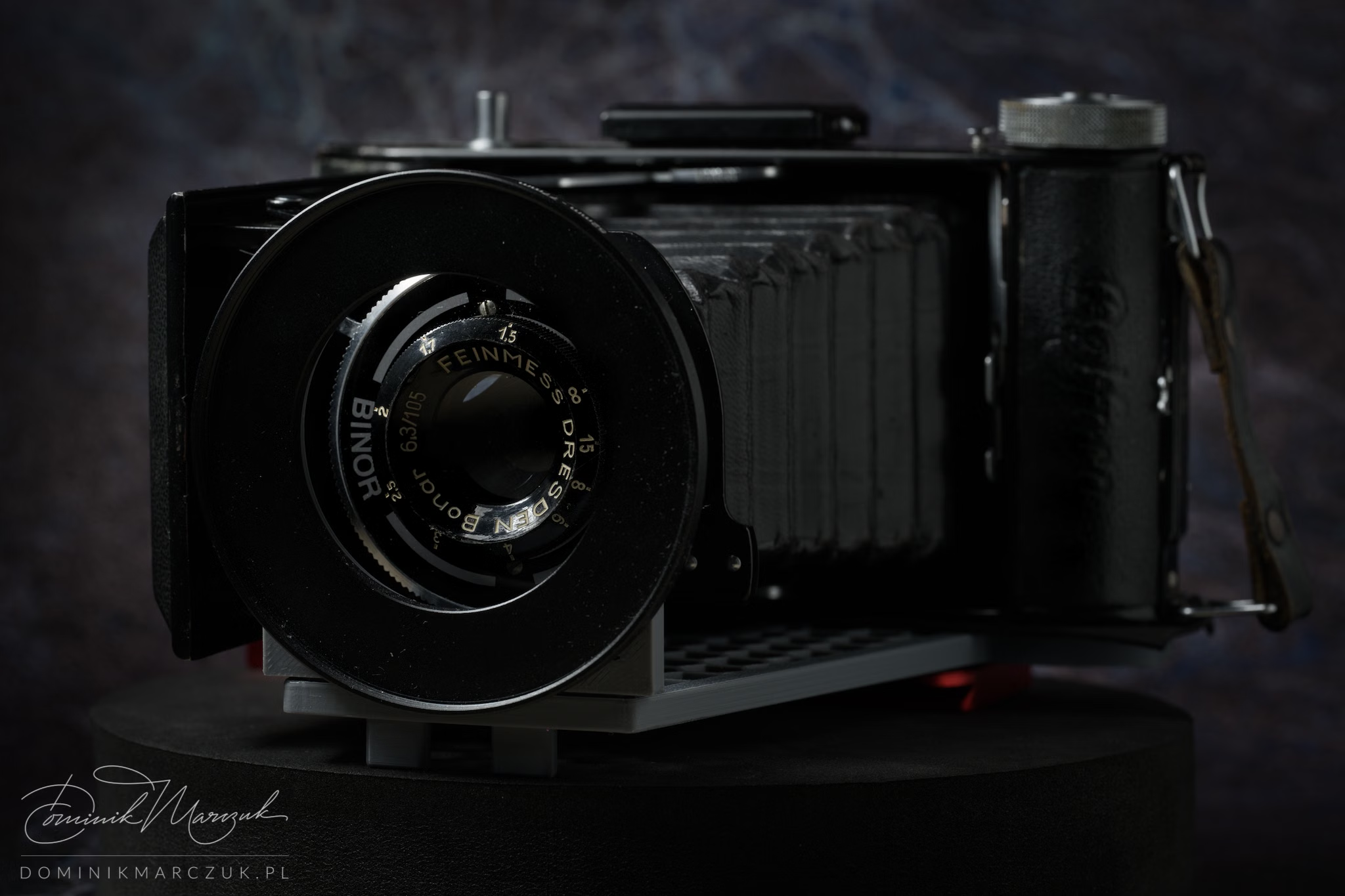
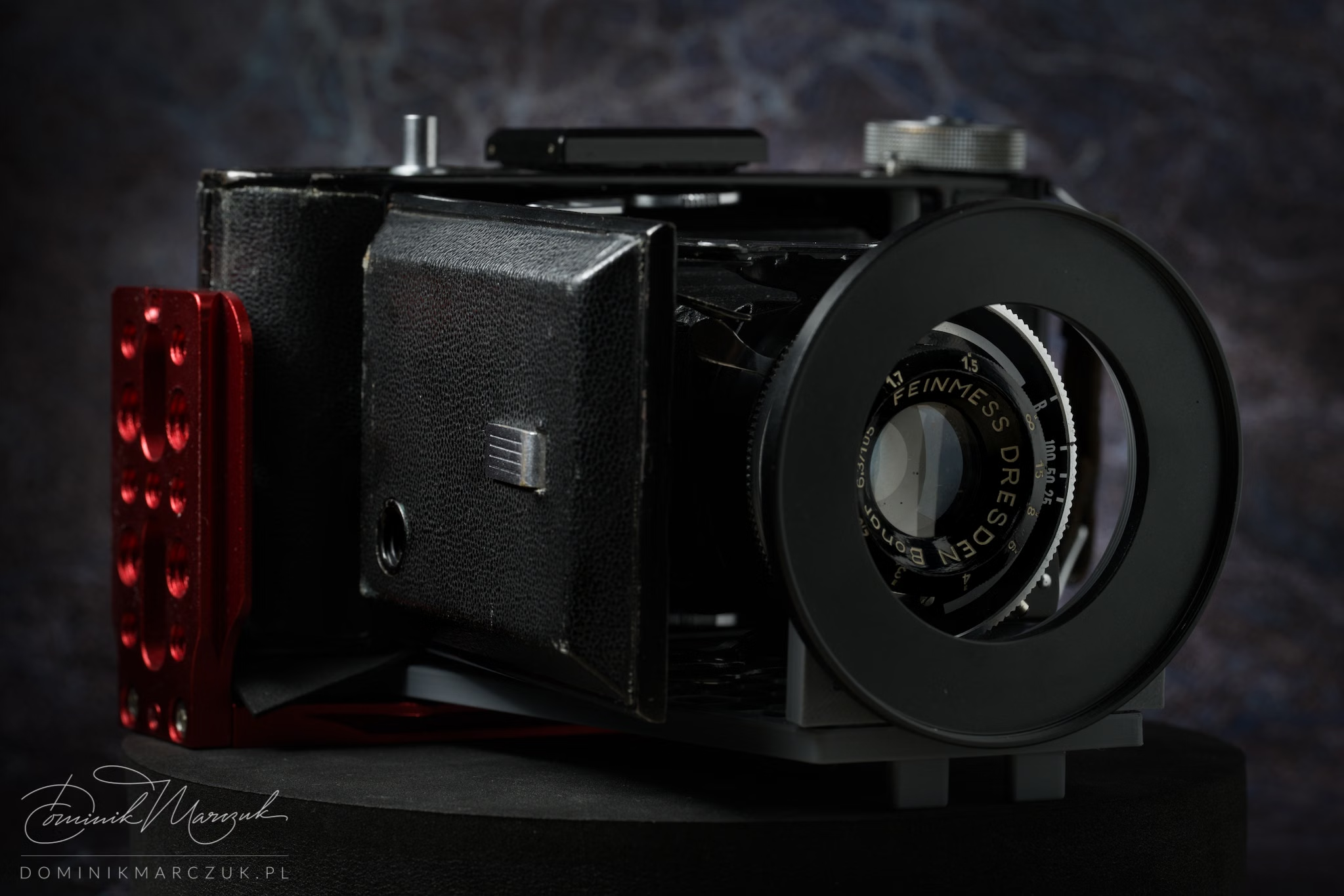
I mentioned 3D-printed adapters earlier. While I don’t need dedicated 6x6 or 6x4.5 frames since I own cameras built for those formats, I decided to tackle issue 4 with a custom accessory. My solution was a 5 mm spacer designed to sit between the camera base and an Arca-Swiss L-bracket. This spreads the clamping pressure across a much larger surface, dramatically improving stability while allowing me to seamlessly switch between landscape and portrait orientations.
Additionally, I wanted to incorporate a front filter thread. It can’t sit too close to the glass, or it blocks focus adjustments and shutter value changes. Because stray light reflecting off a filter can wash out contrast, I make a point of shading the contraption when shooting with the sun behind me.
Combining these concepts into a single design, I sat down at my CAD software and iterated until I had something robust. The next logical step is integrating a smartphone mount to provide a true built-in live-view screen.
As for the focus estimation dilemma (issue number two), I opted to pick up a laser rangefinder, ensuring I can measure exact subject distances and translate them to the lens barrel with confidence. Note: it’s advisable to pick up a rangefinder with a green laser dot. I started with a standard red one, and it turned out to be impossible to spot in daylight at distances longer than 5 m.
Image Quality
Let’s be realistic: the optical performance of a 75-year-old folding camera sporting an uncoated Cooke triplet isn’t going to rival modern glass, or even lenses from fifty years down the line. Yet, the Bonar lens managed a pleasant surprise.
Centre sharpness is more than acceptable. I wouldn’t call it “razor-sharp”, even stopped down to f/16 or f/22, but given the massive 6x9 cm negative size, it provides plenty of resolution. The corners, naturally, turn mushy regardless of aperture - a hallmark trait of vintage triplets. It’s all part of the charm.
I haven’t been brave enough to thoroughly test its resistance to flare. Given the elevated per-frame cost of shooting the Belfoca, I’d rather focus on making keepers than court disaster. Even without the sun directly in the frame, images emerge with a naturally low contrast profile. Far from being a flaw, this actually works to my advantage, allowing me to pair the camera with punchy, high-contrast budget stocks like Fomapan 100 or Kentmere 100.
I also ran a roll of Kodak Gold 200 through it, yielding surprisingly decent colour work. Chromatic aberration is practically absent - something I honestly anticipated seeing - and sharpness matches its monochrome counterparts, with a colour rendition indistinguishable from my other vintage gear.
Overall, the Bonar optic can only be described as “characterful.” It delivers a nostalgic look that I suspect would be terribly difficult to replicate digitally.
Verdict
On its own, the Belfoca’s usability is heavily compromised. It offers a 1930s user experience that, by modern metrics, is downright terrible, completely lacking the conveniences we take for granted today. Yet, with patience, a bit of ingenuity, and modern problem-solving, it can be transformed into a surprisingly capable rig - slow, unforgiving, but immensely rewarding.
Even with contemporary crutches like laser rangefinders and phone viewfinders, it remains a demanding companion. The mental discipline of immediate film winding, the guesswork of zone-focus depth of field, and the distinct signature of an old triplet lens keep you on your toes.
Ultimately, photography comes down to fun. And the Belfoca is undeniably fun. It’s light, compact, and capable of rendering gorgeous, atmospheric images. Despite unpredictable results, I thoroughly enjoy using it. It forces me to slow down, rethink my compositions, and let 3D-printed engineering push a relic of the past well beyond its original limits.
Belfoca
Photos taken using the Belfoca camera.